
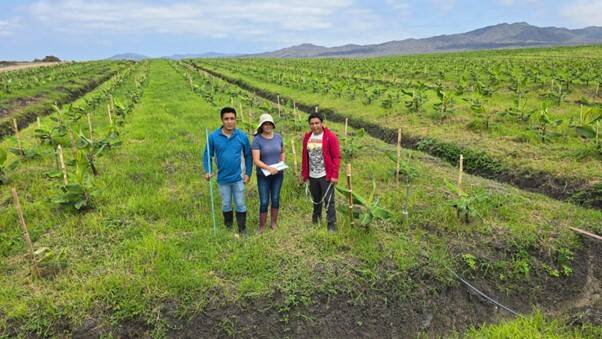
The banana, plantain, and other wilt Program, through the ATN/RF-18761-RG projects from Fontagro, ALER4TA (Biodiversity & CIAT Alliance), and DAPME (INIAP), which include among their objectives the diversification of the productive systems of Musaceae in Ecuador, has introduced banana germplasm with partial resistance to the pathogen Fusarium oxysporum f. sp. cubense tropical race 4 (Foc R4T), responsible for the wilting of Musaceae.
Foc R4T, present in 17 countries worldwide, entered Latin America in 2019, first in Colombia, then in Peru, Venezuela, and was recently reported by Agrocalidad in Ecuador. It is a pathogen that spreads easily, and in the areas where it establishes itself, banana production becomes impossible.
Strategies to recover infected plantations have not been successful; biological or chemical control alone is insufficient. Therefore, genetic resistance is the best option to address the issue. Countries such as Mozambique and the Philippines have restored banana production in affected areas by replacing susceptible cultivars with those that have partial resistance.
INIAP imported seedlings of the GCTCV-218 material (commercially registered as Formosana), obtained from the Taiwan Banana Research Institute (TBRI), as it is a highly adopted option in Cavendish-type banana production systems, both for its partial resistance to Foc R4T and its market acceptance as a Cavendish type. Together with Rahan Meristem of Ecuador, six varieties of GAL bananas were also imported, which also possess partial resistance to Foc R4T.
Since their introduction, evaluations conducted by INIAP in experimental plots have aimed to determine the adaptation of the introduced materials to Ecuador's agro-climatic conditions and to compare their agronomic management against local cultivars. With the recent confirmation of the presence of Foc R4T in the country, these tests are gaining greater relevance, as they will provide key information about the performance of materials with partial resistance and their response to other locally important pathogens, such as black Sigatoka and bacterial wilt.
The anticipation in introducing and evaluating germplasm with potential resistance to Foc R4T before the pathogen's incursion constitutes a strategic and forward-looking action that demonstrates how science directly contributes to the sustainability of the Musaceae production sector. The availability of adapted and resistant materials will allow for a quicker and more effective response to potential outbreaks, ensuring the continuity of production and the competitiveness of Ecuadorian bananas in international markets.